Biodiesel and AUS32 (AdBlue) Production Equipment: ReX-100B and ReX-100
The ReX-100 system is designed for producing AUS32 (AdBlue) fluid for catalytic converters, while the ReX-100B is built for biodiesel fuel production. These units serve a broad range of users, from small businesses and farms to home use. No special skills or high operator qualification are required to run them. The ReX-100 and ReX-100B can produce up to 100 liters of biodiesel or AUS32 (AdBlue) per hour. At the heart of these innovative systems is the RX-34 magnetic-pulse cavitation processor, delivering a fundamentally new approach to the transesterification reaction or urea dissolution process. High-frequency magnetic-impulse cavitation treatment takes place inside the processors at the molecular level, exposing every component to the effects of magnetic-impulse cavitation.
Key advantages of the ReX-100B equipment:
- The ReX-100B does not require high-grade source oil or animal fat. High-frequency processors with magnetic-impulse cavitation deliver successful, stable operation using waste vegetable oil from restaurants and bakeries, animal fat, pork or chicken fat, and mixtures of these as feedstock. Switching between different source oils or fats requires no special adjustments to the unit.
- The required amount of methanol and catalyst is minimal, and alcohol recovery isn’t needed. Thanks to the cavitation technology, the alcohol volume used in the reaction matches the stoichiometric ratio precisely, meaning the smallest possible volume.
- Production time for finished biodiesel is cut several times over. With traditional technology, it’s impossible to obtain properly finished biodiesel right away – it has to be washed with water to remove impurities, then dried to remove the water, adding extra time along with extra energy and production costs. With the cavitation production method, neither washing nor drying the finished product is required.
- The quality, reliability, and safety of our compact equipment are backed by years of operation and positive feedback from our customers.
Key advantages of the ReX-100 equipment:
- Minimal power consumption.
- High capacity.
- Maximum quality of the finished product.
- Minimal weight, dimensions, and footprint.
- The process runs at a reduced temperature and requires no additional heating.
How Biodiesel and AUS32 (AdBlue) Production Equipment Works
Operating description: ReX-100B – biodiesel production (Image 1)
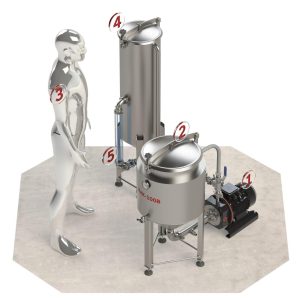
Image 1
The operator [3] (shown here at 180 cm for scale) fills tank [2] with the formulation-required amount of oil and switches on cavitation reactor [1]. The oil circulates in a closed loop between tank [2] and cavitation reactor [1], heating up as it flows. Right after that, the operator adds the alcohol-catalyst mixture into tank [2], which passes through a special hydrodynamic distribution device inside tank [2]. The alcohol-catalyst mixture is introduced evenly into the oil, with simultaneous heating and cavitation treatment in reactor [1].
Once the mixture reaches 70°C, the reacted mixture is pumped into a separation tank [4], where it splits into biodiesel and glycerin. The separation process is monitored through sight glass [5]. Once the reacted mixture has fully separated, the glycerin is drained first, followed by the biodiesel. The draining process is monitored through sight glass [5].
Operating description: ReX-100 – AUS32 (AdBlue) production (Image 2)
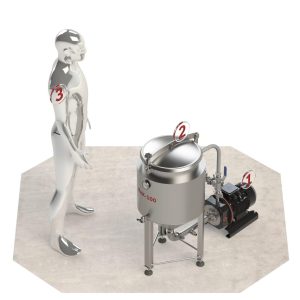
Image 2
The operator [3] (shown here at 180 cm for scale) fills tank [2] with the formulation-required amount of demineralized water and switches on cavitation reactor [1]. The water circulates in a closed loop between tank [2] and cavitation reactor [1], heating up as it flows. Right after that, the operator adds dry urea (carbamide) into tank [2], which passes through a special hydrodynamic distribution device inside tank [2]; the urea is introduced evenly into the demineralized water, with simultaneous heating and cavitation treatment in reactor [1]. After five minutes of processing, the finished product – AUS32 (AdBlue) – can be drained.
| Technical parameters |
ReX-100 |
ReX-100B |
| Max. capacity, L/h |
100 |
100 |
| Installed power, kW |
4 |
4 |
| Max admissible operating temperature, °C |
90 |
90 |
| Degree of automation |
manual |
manual |
| Floor space per module, m² |
0.55 |
0.99 |
| Dimensions (L × W × H), mm |
1100×500×1050 |
1100×900×1450 |
| Explosion-proof certification |
ATEX |
ATEX |


 United Kingdom
 Germany
 Netherlands
 France
 Bulgaria
 Hungary
 Moldova
 Poland
 Romania
 Slovakia
 Czech Republic
 Latvia
 Lithuania
 Greece
 Spain
Spain Italy
Italy Portugal
 Serbia
 Croatia
 Turkey
 Georgia
 Armenia
 Cyprus
 Indonesia
 New Zealand
 Argentina
 Brazil
 Chile
Chile Colombia
 Mexico
 Panama
 Paraguay
 Uruguay
 India
India Pakistan
 Bahrain
 Qatar
Qatar Kuwait
 United Arab Emirates
 Oman
Oman Saudi Arabia
 Vietnam
 Canada (excluding Greenland)
 United States
 Japan
Japan