Production of AUS32 Catalytic Fluid (AdBlue Type) Automated Machine DEF CT500

AUS32 catalytic fluid (AdBlue type) is a specialized liquid reagent (an aqueous solution of 32.5% urea and 67.5% demineralized water) used in modern diesel engines equipped with Selective Catalytic Reduction (SCR) systems. It is designed to reduce harmful nitrogen oxide (NOx) emissions into the atmosphere by 90% or more, ensuring compliance with Euro 5 and Euro 6 environmental standards. AUS32 consumption typically accounts for 4-7% of the engine’s diesel fuel consumption.

Our technology is based on the use of a cavitation reactor for the instant dissolution of urea in water. In the DEF CT500 system, a mixture of urea and water in the required proportion is pumped through the cavitation reactor. During this process, solid urea crystals are effectively broken down into nanoparticles by shock waves generated from the implosion of cavitation bubbles. In this state, the surface area-to-volume ratio of urea increases significantly, allowing it to dissolve in water within seconds. The energy of cavitation is ultimately converted into thermal energy, enabling the dissolution process to occur without additional heating. This is exactly what makes our AdBlue production system popular worldwide.
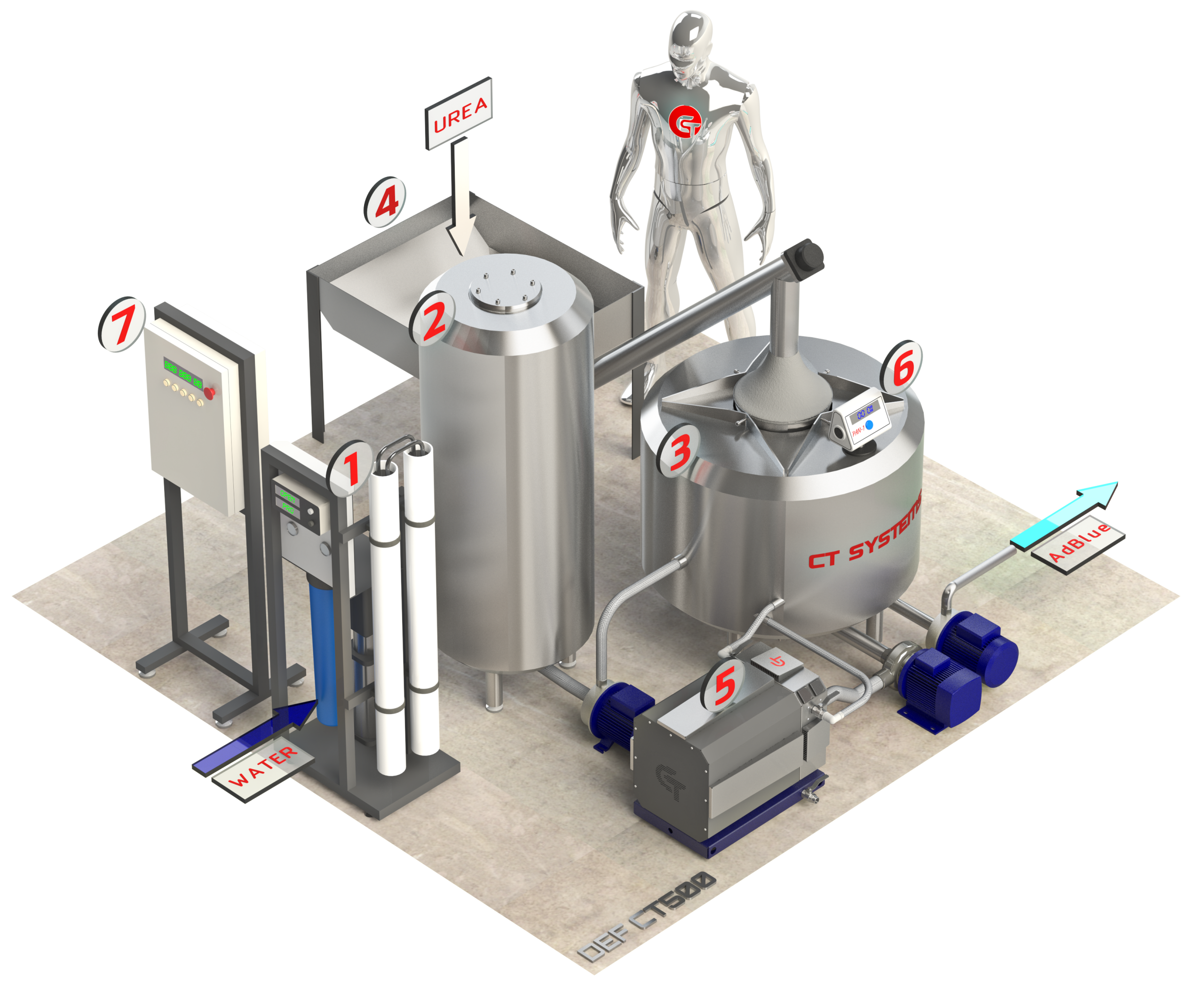
Adblue manufacturing equipment

Operating Principle of the DEF CT500 AdBlue Production System


Water [WATER] from an external source is supplied to the [1] reverse osmosis purification unit and then pumped by an integrated pump into the buffer tank [2].

From the buffer tank [2], the purified water is pumped by a high-performance pump into the [3] AUS32 (AdBlue type) preparation tank. The volume of water required for solution preparation is controlled by a dedicated sensor installed in tank [3].

After tank [3] is filled with water, urea [UREA] is fed into the system via a screw feeder [4]. Due to the special design of tank [3], urea does not come into direct contact with the bulk water inside the tank but is instead delivered together with water directly into the cavitation reactor [5]. This approach of our AdBlue manufacturing equipment compensates for the temperature drop caused by the endothermic reaction. The urea-water solution from the reactor is then returned back to tank [3].

The concentration of the solution in tank [3] is continuously monitored in real time by an industrial refractometer [6]. Once the concentration reaches 32.5%, the supply of urea [UREA] is stopped, and the finished solution (~500 liters) is pumped into storage tanks for AUS32 (AdBlue type) at the production facility.

The entire process is controlled by a PLC (Programmable Logic Controller), eliminating the risk of human error.

Technical Specifications of the Exhaust Fluid Making Machine

  • Capacity – 500 liters per hour (up to 12,000 liters per day)
  • Energy consumption – 3.5 kWh (0.007 kWh per liter)
  • Dimensions (L × W × H) – 3 × 3 × 1.65 m
  • Total weight – 450 kg
  • Material – stainless steel

Advantages of the Cavitation Method (Patented U2025 06080) in the AdBlue production facility

  • Minimal energy consumption
  • High productivity
  • Maximum quality of the final product
  • Full process automation
  • Compact size, low weight, and minimal footprint
  • The process occurs at reduced temperature and does not require additional heating
  • Automatic quality control of the finished product

Conventional Urea Dissolution Method vs Cavitation Method for AdBlue production

Urea is a salt that is soluble in water. The dissolution of urea in water is an endothermic reaction, meaning it absorbs heat. If 32.5 parts by mass of urea are dissolved in 67.5 parts by mass of water, the temperature of the final solution will drop below 0°C. Therefore, during the dissolution process, the temperature is maintained at 50-75°C, and the solution is continuously mixed to sustain the dissolution rate.

A precisely measured amount of demineralized water is poured into a stainless steel tank, and a measured amount of urea is added. The tank is then heated while mixing devices operate inside it. The dissolution process may take one hour or more. The finished solution is filtered and transferred to storage.

To maintain an adequate dissolution rate, the temperature inside the tank must remain within 50-75°C. The solubility of urea in water depends on temperature: if the temperature drops, the solubility limit may fall below 32.5%, making it impossible to produce a solution of the required concentration.

Disadvantages of the Conventional Method in the AdBlue-making machine

  • The process operates in batch mode
  • High energy consumption for heating the solution
  • Low dosing accuracy of components
  • Slow dissolution rate
  • Large equipment footprint